Wide Overload or Central Crowding?
Wide overload or central crowding: compare where extra attackers can combine, what each route concedes, and how to recognize the right opening.
The common mistake with a wide overload or central crowding is to count nearby attackers and call the side with more bodies the better option. That can leave a winger boxed in by the touchline or send another midfielder into a centre already sealed by defenders; the numbers look promising, but the ball has nowhere useful to go.
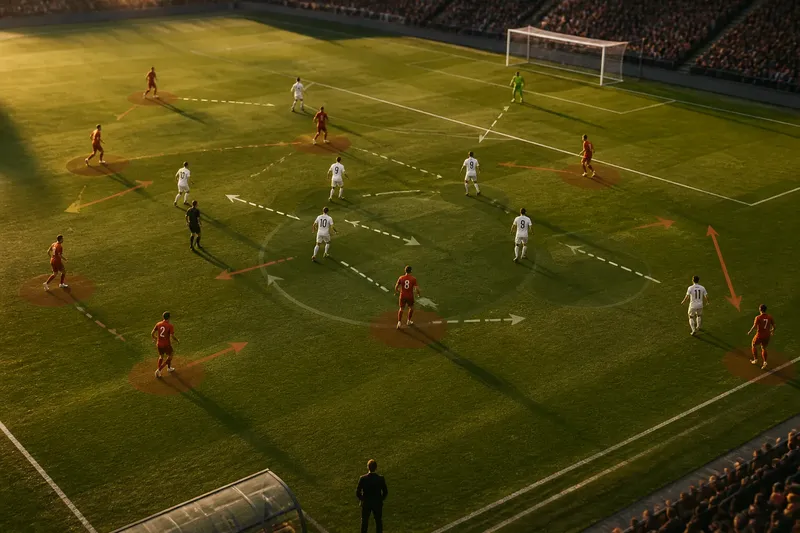
The real choice is about the next action. A wide cluster can draw opponents outward and make a route around them; a central cluster can connect passes through the most direct corridor. Each asks the attack to accept a different risk, and neither works just because extra shirts arrive.
Wide overloads
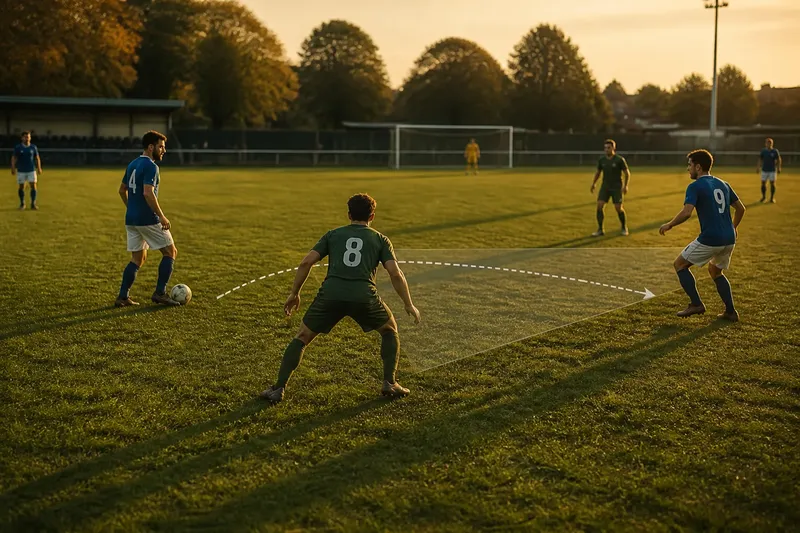
A wide overload places several attackers near the ball on one flank, often a winger, an overlapping fullback and a midfielder arriving inside. Their positions should offer different angles, not form a queue along the sideline. One player can hold width, another threaten the space behind, and a third offer a short pass inside.
The touchline acts as an extra defender: it removes one escape direction. That makes a wide combination readable if the ball carrier receives with their back to the field or if the supporting players stand on the same line. The useful arrangement keeps at least one option facing forward and one able to return the ball into the pitch.
Wide overloads are especially useful when the opposing fullback is isolated or the nearest midfielder is slow to cover across. A quick exchange can make the fullback choose between stepping toward the ball and protecting the run beyond. If a second defender arrives, the attack may still have gained something: the far side can become less crowded, provided the team can switch play with control.
But crowding a flank can also trap the attack there. A pass into the corner is not progress by itself, and repeated short passes may let the defense recover its shape. The group needs a clear exit: a cutback toward the edge of the penalty area, a pass back to a free midfielder, or a diagonal switch to the opposite side.
Central crowding
Central crowding brings several attackers into the lanes between the opposing midfield and back line. A striker can pin a center back, a midfielder can receive between lines, and another runner can arrive beyond them. The attraction is directness: a single combination may reach a shooting position before the defense can shift.
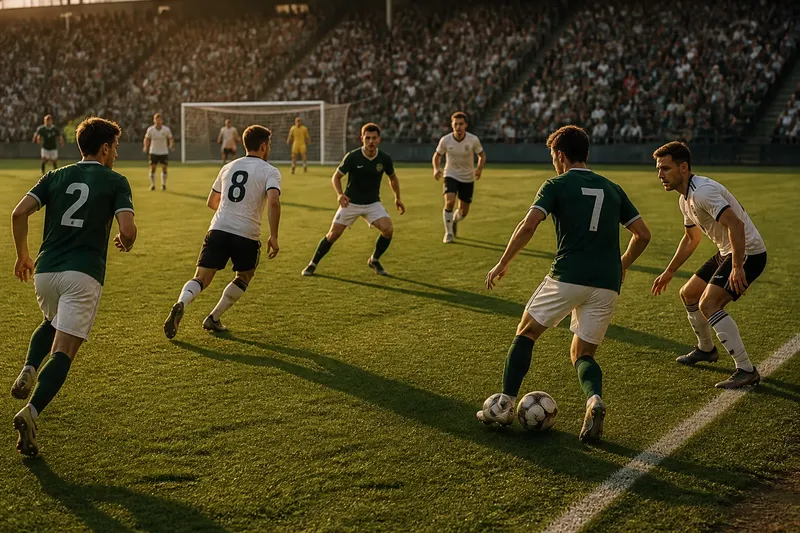
The price is limited room to turn. In a congested centre, a first touch toward a defender can end the move; a square pass may invite interception, and a forward-facing receiver can be surrounded before support arrives. The attack needs movement around the ball, not just more players close to it.
Staggering matters. If one attacker checks toward the pass, another can run behind the defense while a third holds a position for a layoff. Those different heights make it harder for defenders to guard every option at once. When all three arrive at the same depth, the defense can keep them in view and close the central lane as a unit.
Central combinations suit attacks that can pass sharply under pressure and have runners prepared to move before the ball arrives. They are less attractive when the opposition protects the area in front of its center backs with several compact midfielders. In that situation, forcing another pass through the crowd may be less productive than moving defenders toward a flank first.
What does the picture reveal?
When should an attack overload the wing?
Look for an isolated defender, a teammate able to run beyond, and a free player positioned to recycle or switch. If the ball carrier has only the touchline behind them and nearby support at the same angle, the overload is likely to become a trap rather than a way through.
When is the centre too crowded?
It is too crowded when receivers cannot turn, runners share the same lane, or every forward pass requires threading the ball between several defenders. A central cluster can still work if movement creates a brief gap, but proximity alone is not evidence that the gap exists.
Can a wide attack create a central chance?
Yes: a flank combination can pull defenders toward the ball, then set up a cutback or a pass to a midfielder arriving outside the penalty area. The attacker making that final pass should look for a teammate in a clear lane rather than cross automatically.
Can a central attack make room out wide?
Yes: a midfielder receiving between the lines may draw a defender inward, opening space for a fullback or winger outside. The wide runner must time the move to the defender’s response; running early can simply bring another marker into the same area.
Choose the route
Read the defenders’ body positions before committing extra players. If the nearest wide defender faces the touchline and has little cover, a flank combination may force a difficult decision. If that defender is already supported and the central line has a receiver able to face forward, the inside route may be cleaner.
Also notice where the next defender is coming from. When a midfielder moves wide to help, the space they leave can be more valuable than the flank itself. A pass inside after drawing that midfielder away may turn a wide overload into a central opening; the aim is not to stay loyal to the first route, but to use the response it produces.
Imagine a right winger receives near the sideline with the opposing fullback in front and a midfielder closing from inside. The winger’s fullback overlaps while a central midfielder stays behind the ball; if the fullback draws the defender, the winger can slip a pass into the run, while the midfielder remains available for a return or a switch. If the defender holds position and the inside lane stays open, the winger can instead feed the midfielder and move beyond for a return pass.
That small choice is the point: the same starting cluster can become a wide attack or a route through the centre. A useful wide overload or central crowding gives the ball carrier a visible next option and gives the rest of the team a reason to move. If either is missing, adding another attacker may only add another defender to the scene.
Keep the far side alive
When several players gather near the ball, someone on the opposite flank should usually remain available to receive a switch or attack the space after one. That player does not need to stand motionless on the touchline; they can adjust as the ball moves, staying far enough away to stretch the defense without disconnecting from the play.
The far-side option changes the defenders’ calculation. If they all collapse toward the overload, a switch can reach a teammate with room to advance. If they stay wide, the near-side group may have more space for a combination. The attacker who holds that distant position is still contributing, even before they touch the ball.
For a quick match read, track three things: who is nearest the ball, who is behind the opposing line, and who remains free on the far side. A wide overload is promising when those roles are distinct; central crowding is promising when one attacker can face forward and another can threaten beyond. If the same player is expected to receive, turn, create and finish without support, the shape is asking too much of one touch.
Before the next pass, judge the opening by its direction, not its headcount. The better route is the one that makes a defender choose, preserves an exit if the first move closes, and leaves a teammate ready for the space that choice creates.